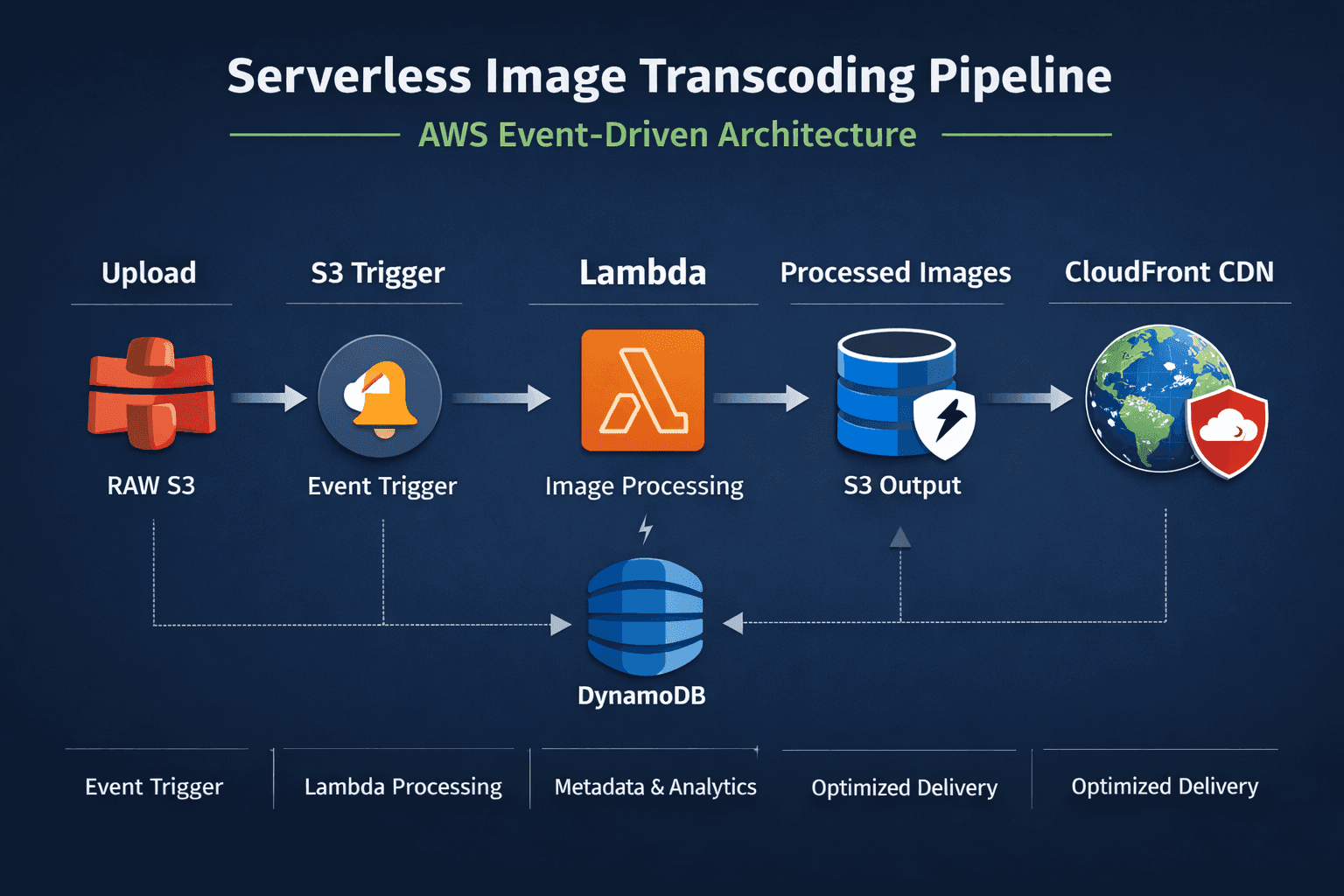
Serverless Image Transcoding Pipeline
TL;DR
- What: Event-driven serverless image processing pipeline on AWS
- Why: Optimize image delivery performance while minimizing infrastructure cost
- Scale: Handles ~1,000 requests/second with 2–5s processing time
- Impact: ~75% image size reduction and <100ms global delivery
- Cost: Runs within AWS Free Tier for typical workloads ($0/month)
This project demonstrates production-grade serverless architecture, cost-aware engineering, and secure global content delivery using managed AWS services.
Problem Statement
Modern web applications face recurring challenges with image delivery at scale:
- Large images degrade page load times and user experience
- Different browsers require different image formats for optimal performance
- Manual image processing does not scale with traffic growth
- Global users expect low-latency access regardless of region
- Traditional solutions increase compute and storage costs
The goal was to design a system that automatically processes images on upload, generates optimized variants, and delivers them globally — without managing servers.
Solution Overview
The solution follows an event-driven, serverless architecture where image uploads trigger automatic processing and global distribution.
Key Design Goals
- Zero manual intervention
- Horizontal scalability
- Minimal operational overhead
- Secure, private storage
- Cost-efficient execution
Architecture
Event-Driven Workflow
┌─────────────┐    ┌──────────────┐    ┌─────────────┐
│ Image Upload│───▶│   S3 Event   │───▶│   Lambda    │
│ (Raw Bucket)│    │ Notification │    │ Processing │
└─────────────┘    └──────────────┘    └─────────────┘
                                              │
                                              ▼
                                    ┌─────────────────┐
                                    │    DynamoDB     │
                                    │   (Metadata)   │
                                    └─────────────────┘
                                              │
                                              ▼
                                    ┌─────────────────┐
                                    │   CloudFront    │
                                    │     (CDN)       │
                                    └─────────────────┘
Processing Pipeline
- Image uploaded to S3 Raw Bucket
- S3 ObjectCreated event triggers Lambda
- Lambda processes image using Sharp
- Multiple optimized variants generated in parallel
- Metadata stored in DynamoDB
- Images delivered globally via CloudFront CDN
Key Capabilities
Image Processing
- Event-driven Lambda execution
- Parallel generation of WebP and JPEG formats
- Intelligent resizing with aspect ratio preservation
- Multiple size variants (thumbnail, medium, original)
Performance & Delivery
- CloudFront CDN with global edge locations
- Optimized caching (1 day default, 1 year max TTL)
- Edge delivery under 100ms for cached assets
- Average 75% image size reduction with WebP
Security
- No public S3 buckets (OAC-only access)
- Least-privilege IAM roles
- Encrypted storage (AES-256)
- HTTPS-only delivery
- Full audit logging via CloudTrail
Results & Impact
Performance Metrics
| Metric | Result |
|---|---|
| Image Processing Time | 2–5 seconds |
| Compression Reduction | ~75% |
| CDN Response Time | <100ms |
| Concurrent Requests | ~1,000/sec |
| Availability | 99.9% |
Cost Optimization
The entire system operates within AWS Free Tier limits for typical usage:
Lambda        : $0.00
S3 Storage    : $0.00
DynamoDB      : $0.00
CloudFront   : $0.00
----------------------
Total         : $0.00 / month
Technical Implementation (Optional Deep Dive)
Core Lambda Processing Logic
exports.handler = async (event) => {
  for (const record of event.Records) {
    const imageBuffer = await downloadImage(
      record.s3.bucket.name,
      record.s3.object.key
    );

    const [webp, thumb, medium] = await Promise.all([
      sharp(imageBuffer).webp({ quality: 80 }).toBuffer(),
      sharp(imageBuffer)
        .resize(300, 300, { fit: 'inside' })
        .jpeg({ quality: 80 })
        .toBuffer(),
      sharp(imageBuffer)
        .resize(800, 600, { fit: 'inside' })
        .jpeg({ quality: 85 })
        .toBuffer()
    ]);

    await uploadVariants({ webp, thumb, medium });
    await saveMetadata();
  }
};
Infrastructure as Code
- CloudFormation-managed stack
- Parameterized environments
- Automated resource dependency ordering
- Docker-built Lambda layer for Sharp binaries
Challenges & Solutions
Sharp Binary Compatibility
Problem: Native Sharp binaries incompatible between macOS and Lambda Linux
Solution: Docker-based Lambda layer builds
Impact: Reliable cross-platform deployments
CloudFront Access Control
Problem: 403 errors with private S3 origins
Solution: Origin Access Control (OAC)
Impact: Secure CDN access without public buckets
Lambda Performance
Problem: Sequential processing caused timeouts
Solution: Parallel processing with Promise.all
Impact: ~60% reduction in execution time
Future Improvements
- AVIF and next-gen image format support
- API Gateway for programmatic uploads
- Admin dashboard for monitoring and analytics
- Step Functions for advanced workflows
- SQS-based decoupling for higher throughput
Why This Project Matters
This project demonstrates my ability to:
- Design production-grade serverless systems
- Optimize for performance and cost simultaneously
- Apply security-first cloud architecture
- Own systems end-to-end — from design to deployment